Arizona Allergenic Plants - Plant Guide

Aligator Juniper (Juniperus deppeana)

Alligator Juniper

Alligator Juniper Payson, Arizona

Juniper is an evergreen coniferous shrub or small tree found at higher elevations throughout Arizona.  Most common are the  Aligator Juniper (named because of it’s distinctive rough bark) and Oneseed Juniper.  Both produce allergenic pollen during winter through early spring, and although these trees are not common in the desert regions, the pollen finds it’s way into the valley  in sufficient quantity to cause significant symptoms in sensitive individuals.  Several ornamental varieties of Juniper and Cedar are used in landscapes in the valley.   Because the pollen of most varieties of Juniper and Cedar are closely related, if you are allergic to one, you will have problems with all.

Arizona Ash (Fraxinus velutina)

Arizona Ash (Fraxinus velutina)

Arizona Ash (Fraxinus velutina)

Arizona Ash is a medium to large deciduous ornamental shade tree used in landscaping throughout Phoenix.   Because of it’s high water requirements, it is infrequently used in desert landscaping and therefore is less common in the newer communities of Ahwatukee, Chandler, and Maricopa, although it can be found frequently in older parts of Ahwatukee, equestrian properties such as Warner Ranch, as well throughout Tempe, Scottsdale, Mesa, and Central Phoenix.  It should not be confused with the more common Shamel Ash which is not an allergenic tree. The Arizona Ash is in the same family as the Olive tree (Oleaceae family) and  individuals who are sensitive to Olive tree pollen will also have problems when exposed to Ash tree pollen.

Pollination: February through April

Flowers

Bermuda grass (Cynodon dactylon)

Bermuda Flower

Bermuda grass flower (Cynodon dactylon)

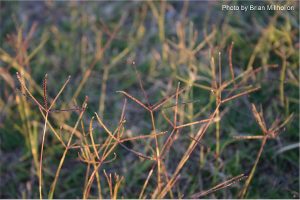
Because of it’s resistance to heat and drought, Bermuda grass is well suited for Arizona and the desert southwest.  Common Bermuda is propagated by seed and produces significant amounts of pollen. It is used extensively in school sports fields, parks, golf courses, and green belts.  Hybrid Bermuda grasses such as Tif and Midiron, are the result of mating common Bermuda grass with African Bermuda grass resulting  in a plant with a finer leaf texture and which does not produce pollen or seed.    These hybrid varieties are used in many home lawns and smaller fields.     In 1994, Phoenix passed the Airborne Pollen Ordinance which requires that Bermuda grass lawns be kept short to prevent pollen-producing seed heads (see picture)  from forming.  It pollenates May through October

Burro Brush (Hymenoclea salsola)

Burro Brush

Burro Brush (Hymenoclea salsola)

Burro Brush, also called White Burro Brush, is found throughout the Sonaran desert of Arizona.  It is wind pollinated, and a significant cause of allergy symptoms in the spring.

Pollinates: March-April

(Flower)

Canyon Ragweed (Ambrosia ambrosioides)

canyonragweed_sm

Canyon Ragweed (Ambrosia ambrosioides)

This large plant can grow to 6 feet and is common throughout southwestern Arizona and the southern half of Baja California. It can be found in desert washes, irrigation canals, and road sides. The flower is wind-pollinated and the pollen can cause allergy symptoms in individuals sensitive to other varieties of ragweed.

Pollinates: March-June

(More)

Careless Weed (Amaranthus palmeri)

Careless Weed

Carelessweed (Amaranthus palmeri)

A type of pigweed, this wind pollinated weed is not native to Arizona. It may be found along road sides, in agricultural area, ditches, and vacant fields in the fall.  It can be found covering open fields in September through November in the Phoenix area if monsoon rains have been frequent.

Pollinates: May through November

Desert Ragweed (Ambrosia dumosa)

Desert Ragweed (Ambrosia Dumosa)

Desert Ragweed is a small shrub (2 ft) found throughout the Sonoran desert.  It is dormant throughout most of the year but comes to life during the spring, particularly if winter rains have been substantial, sprouting leaves and flowers until the heat of summer sets in.  In some areas, depending on rainfall and elevation, Desert Ragweed may pollinate in the fall as well as spring.  It is one of the most prevalent varieties of Ragweed in South Mountain Park and desert areas surrounding Ahwatukee.

Pollinates: March-May

(More)

Johnson Grass

Johnson Grass

Johnson grass (Sorghum halepense)

Johnson Grass is found in washes, along road sides and other areas where there is enough water.  Although it is an allergenic grass,  pollen counts in the Phoenix area tend to be low because of it’s sparse distribution.   It pollenates May through October.

Mulberry Tree (Morus Alba)

Mulberry (Morus alba)

The Mulberry tree (also know as Fruitless Mulberry or White Mulberry)  is often cited in stories  relating how Arizona went from a favored destination for allergy sufferers to one of the worst places to live if you have allergies.   New Arizona residents moving in from the South and East preferred the stately, large-leaved, shade trees they left behind to the local desert varieties and so   thousands of Mulberry, Olive, and Ash trees were planted throughout the valley.   Spring tree pollen levels in Phoenix were fairly low 40-50 years ago but over the past 30 years,  pollen levels in Phoenix have skyrocketed and along with it,  the Phoenix allergy-misery level.   To stem the flood, Phoenix passed the Airborne Pollen Ordinance which restricted the planting of male Mulberry and Olive trees.  As a result, there are few Mulberry trees in the newer communities of Phoenix such as the Foothills in Ahwatukee, although there are  enough established trees  in the valley to supply the rest of the area with pollen for many years ago come.

Pollination: February through April

Flower 1   Flower 2

Olive Tree (Olea europaea)

Olive Tree (Olea europaea)

The olive tree is native to the Mediterranean, Asia, and Africa and has been cultivated for it’s fruit for thousands of years.    It is a hardy, drought and disease resistant tree well suited for the harsh conditions of the Sonoran desert.  It is an evergreen tree which can grow to 30 ft and has an attractive gray, often gnarled and twisted trunk gaining character with age.  Some trees are hundreds of years old.  The olive tree produces a small,  inconspicuous pale, white flower which is wind pollinated and produces volumes of airborne pollen in the spring.   Olive tree pollen is one of the most potent and sensitizing of the allergenic plants of Arizona.  Because of it’s association  with severe springtime allergy symptoms, the city’s of Phoenix and Tucson have banned the planting of fruiting Olive trees since the 1960s.

Palo Verde (Parkinsonia microphylla)

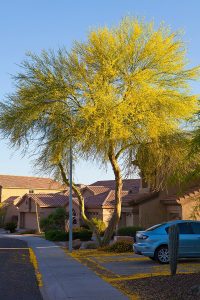
Palo Verde Palo Verde is one of the most common trees of the Sonoran Desert and is found throughout southern Arizona and southeastern California.  Starting in April, the Palo Verde produces a brite yellow flower that stands in contrast to it’s characteristic  green trunk and branches.  In late spring it is common to see the Palo Verde covered in yellow blossoms with a blanket of yellow at it’s base from dropped flowers.  It is this fact that makes the Palo Verde a bit of an allergy enigma.

As a general principle, plants that produce conspicuous and fragrant flowers do so to attract insects such as bees to distribute their pollen.  In addition, the pollen is typically heavy and sticky so that it sticks to the insects rather than being wasted blowing in the wind.  Wind pollenated plans on the other hand produce copious amounts of light pollen that easily catches a ride in a breeze, and often finds it’s way to the nose and eyes of allergy sufferers.   Palo Verde, although an insect pollenated tree, can cause allergy problems just because of the huge volume of flowers that fall to ground, dry, and then picked up by the wind

Rabbit Bush (Triangle Leaf Bursage)

Rabbit Bush (Triangle Leaf Bursage)

Rabbit Bush (Triangle Leaf Bursage) is a member of the ragweed family. It is native to the Sonoran desert and is one of the most commonly encountered plants in South Mountain and McDowell Mountain Parks. It has been used in desert landscaping as a hardy, drought tolerant shrub.

Pollinates: February-May

(More)

Russian Thistle (Salsola kali)

RussianThistle

Russian Thistle (Salsola kali)

Russian Thistle is a common weed throughout the Southwest.  It is not native to Arizona and is found in areas where the natural desert has been disturbed such as vacant fields, roadsides, and agricultural areas.  It is commonly known as Tumbleweed. Like many allergenic weeks, it distributes it’s pollen in the  wind rather than relying on insects or birds  and as a result  is a major contributor to fall allergy and asthma symptoms in Phoenix.

Pollinates: May through November.

(More)